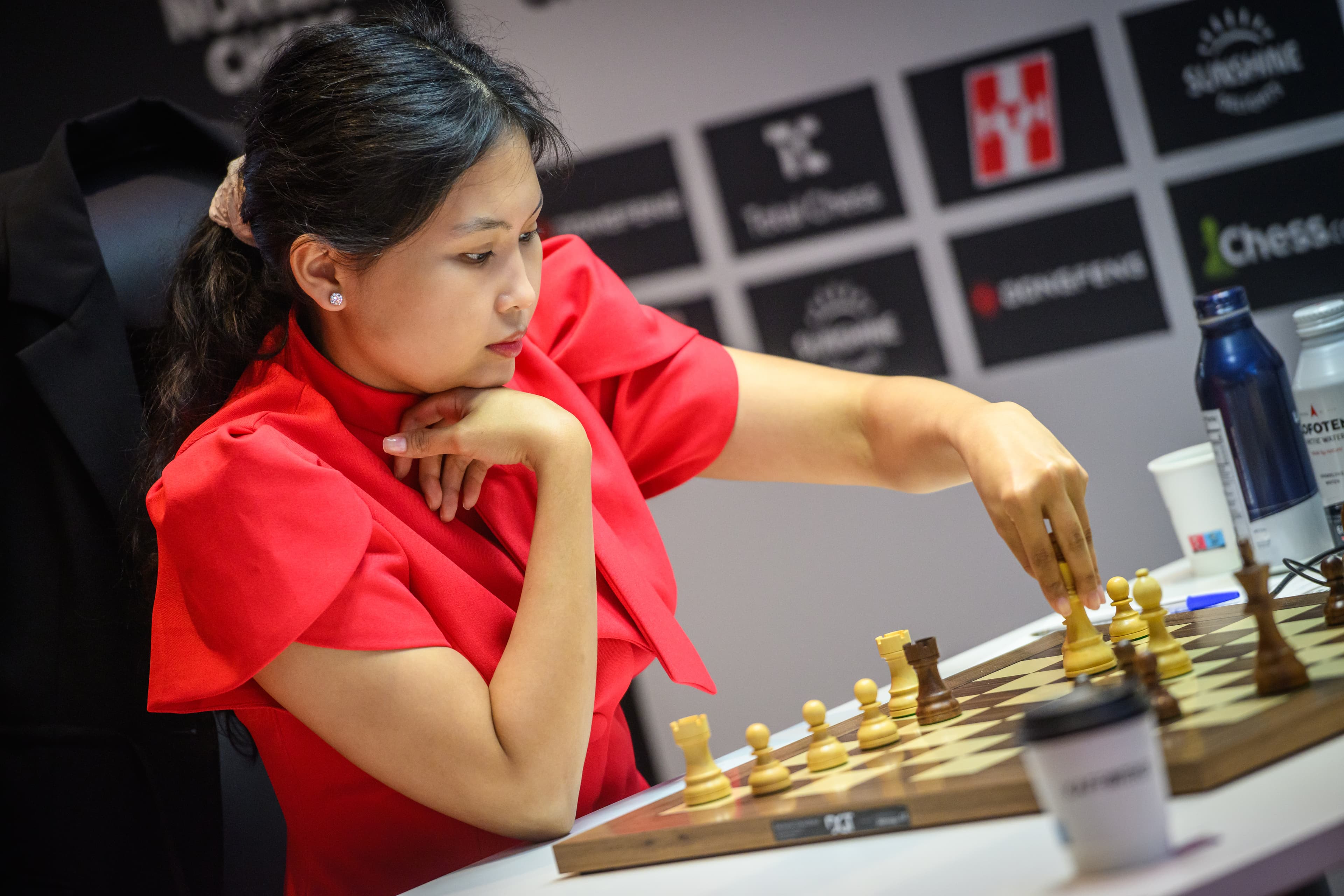
1. A Quick Warm-Up: Blitz Swiss
The event kicks off on 10 November with the opening ceremony and a 9-round Blitz Swiss tournament, played at a time control of 3 minutes plus a 2-second increment per move.
The results will play an important role throughout the competition: the Blitz Swiss standings will serve as the tiebreaker in the group stage and help determine the knockout pairings. The 24 players will then compete in four groups of six.
2. What Happens in the Groups?
Following the opening day's fast-paced action, the group stage begins on 11 November. Over five days, each group will compete in a double round-robin format, meaning every player faces each of their five opponents twice.
With two games played per day, each player will complete ten games in this stage. All group-stage games will use the Fast Classic time control of 45 minutes plus a 30-second increment per move.
What is also absolutely essential to understand is the scoring system here. A win earns three points, a draw one point, and a loss zero points. This system rewards wins more generously than draws, encouraging players to fight for the full point rather than settle for a split. At the same time, every loss becomes even more costly.
Before moving on to the next stage, players will have a rest day.
3. Ruthless Knockouts
The knockout stage brings a new level of intensity: every match matters, and every player is fighting to secure the best possible finishing position.
The top four group winners will compete for the championship title, while the remaining players will enter separate knockout brackets to determine their final positions. The group standings determine which knockout bracket each player enters.
Each knockout match is played over two days, following the same sequence of games: four Blitz games, two Rapid games, and one Fast Classic game. The time control for Rapid is 15 minutes plus a 10-second increment per move.
The points awarded differ significantly between the three disciplines:
Blitz: 1 point for a win, 0.5 points for a draw, and 0 for a loss.
Rapid: 4 points for a win, 2 points for a draw, and 0 for a loss.
Fast Classic: 8 points for a win, 4 points for a draw, and 0 for a loss.
This weighting gives greater importance to the longer time controls while ensuring that every game can influence the outcome.
One particularly important feature is that the scores reset each day. The winner of each day's match is determined by the points collected across the seven games. If the score is even at the end of the second day, an Armageddon game will decide the winner.
The semifinals take place on 17–18 November, setting the stage for the decisive final matches.
Credit: Norway Chess / Michal Walusza
4. The Final Showdown
The competition reaches its climax on 19–20 November, when the two semifinal winners face each other in the final. The same two-day knockout format applies, with Blitz, Rapid, and Fast Classic games all contributing to the daily score.
With the title on the line, every decision carries extra weight. Players must balance speed, precision, and strategic depth across three different time controls, knowing that a single game can change the course of the match.
On 20 November, the tournament will crown its first Total Chess Pilot Champion. After days of intense competition, only one player will claim the title in Budapest.

Credit: Norway Chess / Michal Walusza
Prefer to watch?
Here’s the format explained in under a minute.